
Mural Monday - Water of Heritage
- Ana Gabriela

- 20 hours ago
- 6 min read
Some murals come from referrals. Some come from community connections. And some come from simply taking a chance.
Waters of Heritage was one of those chances.
This mural was part of a large public art call connected to the redevelopment of Terminal 1 on the Vancouver waterfront. The Port of Vancouver and Lincoln Property Company were transforming the site into a mixed-use development and invited artists to submit qualifications for several public art opportunities across the project.

At the time, I had only been painting murals professionally for 2 years. I had applied to many open calls before, but had never actually won one.
So when I saw this call circulating, and when several friends even sent it to me saying “you should apply for this,” I figured I had nothing to lose.
I submitted my qualifications and tried not to think about it too much.
Making It to the Proposal Round
Months later, I received an email saying I had made it past the first jury round.
The next phase was the proposal round, where artists would create a concept specifically for the site. I was given a packet outlining the themes the project wanted artists to explore. These included ideas tied to culture, geography, discovery, water, and industry, all meant to reflect the history and identity of the waterfront.
Suddenly this opportunity felt very real.
And very intimidating.
Like many artists, I am a bit of a procrastinator when it comes to big proposals. I always meet the deadline, but I definitely stress myself out along the way. Once the concept clicked though, everything moved quickly.
I spent an entire weekend designing the piece and writing the proposal.
Designing Waters of Heritage
The mural concept I proposed was called Waters of Heritage.
The goal was to honor the original inhabitants of this land and the deep relationship between people, water, and place. The design uses geometric shapes and flowing forms to represent the waterways and landscapes of the Pacific Northwest. A gradient of blues moves across the mural to symbolize rivers, currents, and the journey of water from source to ocean.
At the center of the piece is a large stylized salmon.

The salmon represents stewardship. A reminder that humans are not the first inhabitants of this land but rather caretakers of it. Interwoven lines travel across the mural to symbolize connection, community, and the pathways created by water. Surrounding the design are forms inspired by Chinook carving traditions, honoring the people who originally cared for this land.
The mural also includes a QR code that links viewers to Chinook stories, history, and ways people can support the tribe today. The goal was not to explain the mural through the code, but to offer a deeper doorway for those who want to learn more.
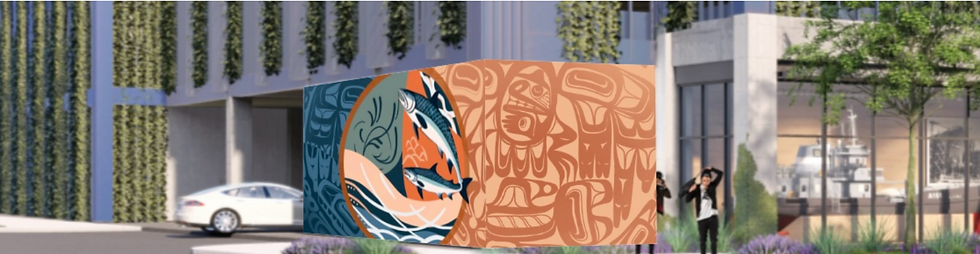
This project was my way of acknowledging that while we cannot undo the injustices of colonization, we can choose to remember, honor, and uplift the history that came before us. We can also do the right thing now by signing petitions and helping our indigenous neighbors get their lands back.
The Email That Changed Everything
After submitting the proposal, I waited.
And waited.
The notification date came and went.
A week passed and I assumed I hadn’t gotten the project.
Then one afternoon I was sitting on my bed answering emails when one popped up that changed everything.
I had won the bid.
I jumped to my feet. I called my boyfriend. I called my mom. I was absolutely overjoyed. It was the first open call I had ever won and it felt like a huge milestone.
Then the excitement settled and I realized something very real.
Now I had to actually paint it.
Painting on an Active Construction Site
The mural was located at the Terminal 1 development site along the waterfront.
Before painting began, we held a full site walkthrough with the superintendent, the Portland Street Art Alliance team (the artist team who won the other mural bid), and the project leads. That meeting taught me something quickly.
Active construction sites are no joke.

There were hundreds of workers on site, strict safety protocols, and constant communication between crews. Everyone had a role, and every role mattered.
I learned about safety plans, job site communication, and the reality that construction sites start very early in the morning.
Which meant I had to become a morning person.
Painting the Wall
When paint day arrived, I jumped in.
The wall was about 1,000 square feet and I primed the entire thing myself in one day.

After that came the base layers and background colors. I purchased my very first 26-foot A-frame ladder and committed to completing the mural primarily from that ladder rather than renting a lift.
My feet definitely had opinions about that decision.
One of the best parts of this mural was that I didn’t have to be completely alone the entire time. My boyfriend came out one day to help me knock out some base layers, which was such a gift when you’re staring down a thousand square feet of wall.


Another day, a friend of mine who wanted to learn more about large scale mural work came to shadow me.


Having them there made the long days feel lighter. Most of the time muralists are out there working solo, so getting to share the process, answer questions, and laugh while painting made those days some of my favorites on the project.
There were also early mornings that began at 4:00 AM so I could project the design before sunrise. Projectors need darkness, and construction sites open early, so those mornings were brutal.

One day I ended up painting for 15 hours straight, the longest day of painting in my career. I got home completely exhausted, ordered takeout because I couldn’t cook, sat on my bedroom floor to eat it, and fell asleep mid bite.
Thankfully I woke up.
Life on the Job Site
Working on a construction site was a completely new experience for me.
There were weekly safety meetings, crews moving everywhere, and constant activity around the building. I was one of the few women working on site, which meant I experienced a full spectrum of construction culture.
Some of it was frustrating. Some of it was incredibly supportive.
When I needed sandpaper one day, I somehow ended up with fifteen different men looking for sandpaper and I ended up with more supplies than I could possibly use.
In the end, I held my own and learned a tremendous amount about how these environments function.
Finishing the Mural
After weeks of painting, the mural was finally complete.

All that remained was sealing the wall with anti-graffiti coating, something I never enjoy using but always appreciate once the job is done.


We finished just in time for the unveiling.
The event was incredible. Artists, architects, construction crews, community members, and city leadership all came together to celebrate the project. Even the mayor attended.


Seeing everyone who contributed to the project standing together in front of the finished work was one of the most rewarding moments of my career.
What It Taught Me
This mural taught me more lessons than almost any project before it.
It taught me how to write a professional proposal.
It taught me how to work safely on an active construction site.
It taught me how to manage a large project on a tight schedule.
It taught me how to collaborate with teams across architecture, construction, and public art organizations.
It also taught me practical lessons.
How to safely work from a 26-foot ladder.
How important safety planning is.
And that I should never paint for fifteen hours straight again.
But the most important lesson was simple.

I learned that I can do things that once felt far outside my reach.
Winning this bid, designing the mural, and completing it successfully showed me that if I put my mind to something and commit to the work, I can accomplish far more than I once believed.
Waters of Heritage will always be one of the murals I am most proud of. Not just because of the finished piece, but because of everything it took to bring it to life.
Supply List
For more supplies go to my amazon storefront


Comments